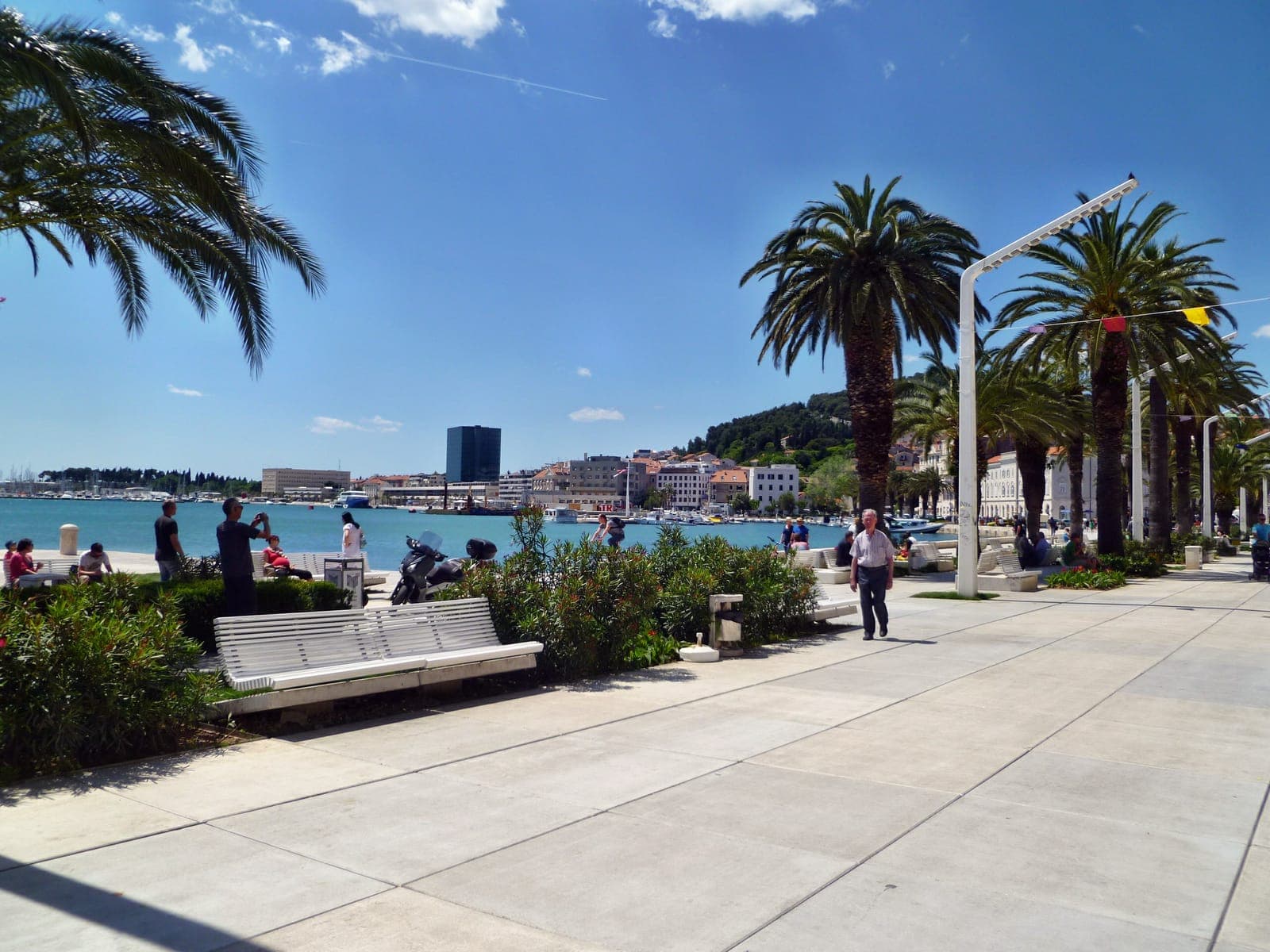
Long-form guides written by people who live in Split: what to expect month by month, how to get from the airport, where to stay, and the questions everybody asks before they arrive.
Take the airport shuttle. It leaves about 30 minutes after every arriving flight and takes around 30 minutes to Split's main bus station, beside the ferry port and a five-minute walk from the old town — €10 one way as of October 2026. City bus 37 is the cheap, slower alternative at €2 prepaid or €4 from the driver. The airport is about 20 km west, at Kaštela.
April is when Split opens up: highs around 18 °C, seasonal restaurants and the first boat trips back, and crowds still light. The sea is only about 15 °C, so it is a walking and sightseeing month — come in late May if swimming matters.
August has the warmest sea of the year, at about 25 °C, and highs of 31 °C — and it is the most crowded month in Split, with Croatians on holiday alongside everyone else. It suits beach-and-boat trips planned around early mornings; anyone with flexible dates should look at September.
November is the wettest month in Split and one of the quietest — the airport carries about a fifth of October's passengers — but highs are still around 16 °C and the sea is near 19 °C. Worth it for a cheap, local city break with museums and long lunches; not for boat trips or beach days.
Winter in Split is 10–12 °C, often sunny, and almost entirely local. No swimming and a reduced ferry timetable, but Advent on the Riva through December, a palace you can have to yourself, and prices at half the summer rate.
Yes, for two to five days, and most of all in June or September. Split is a Roman palace that people still live in, with beaches in town and the islands an hour away by boat. It is not worth it for a party-free week in mid-August, or for anyone who wants sand and silence.
February is Split's quietest month of the year and its coldest sea, at about 14 °C, with highs near 12 °C. It is worth it for Carnival, the Split Marathon and a city entirely to yourself — and wrong for anyone hoping for a swim or a boat trip.
January is Split's quietest and coldest month: highs of about 11 °C, a sea around 15 °C, roughly eight wet days and almost no visitors. Worth it for the palace, the museums and cheap trips to Krka — not for anyone who wants to swim or island-hop.
March is Split waking up: highs around 14 °C, the sea still at about 14 °C, and days that stretch past seven in the evening once the clocks go forward. Good for walking, the palace and cheap Krka visits before prices rise in April — still too early for swimming or island-hopping.
Base yourself in Split if you want islands, day trips, beaches and a city that is still a city. Choose Dubrovnik for two or three nights of the most complete walled town on the Adriatic. For a week, Split; for a long weekend, either; with ten days, both — four to five hours apart.
Split's ferry port is right beside the old town and the main bus station. Catamarans to Hvar and the other islands mostly leave from the berths nearest the Riva; Jadrolinija's car ferries to Brač, Hvar and Vis from the far end of the port, under ten minutes' walk. Supetar is 50 minutes by car ferry, Hvar town about an hour by catamaran (as of October 2026).
Split is mid-priced by Mediterranean standards and no longer cheap. Expect €3 for a coffee, €12–18 for a konoba main, €25–35 for dinner with wine, €10 for a beach lounger and €40–60 a head for a small-boat day trip. Croatia uses the euro.